Tech packsGianni Romano
Best AI Tech Pack Generators in 2026: 5 Tools Compared
- Fashion tech
- Software
Updated 3 November 2026. By Gianni Romano, founder of clothink and co-founder of Lyfcycle.
Creating a clothing tech pack used to mean hours of technical drawing, measurement tables and construction notes. AI is changing that.
Today, you can take a garment from an initial idea to an editable technical specification in one workspace. But not every AI tech pack generator approaches the job in the same way, and not every generated document contains what a clothing factory actually needs.
I know because I work on both sides of that process. I co-founded Lyfcycle, an apparel sourcing and manufacturing business, and I built clothink to simplify the journey from garment design to technical documentation.
Here are five AI tech pack generators worth comparing in 2026: what they cost, where they differ and which I would recommend for an independent clothing brand.
Best AI tech pack generators in 2026: quick comparison
| Tool | Suits | Starting price | One finished pack |
|---|---|---|---|
| clothink (our pick) | Independent designers and growing brands developing a garment from idea to tech pack | Free to start; paid from £19/month | £15 to unlock a pack, or included in a paid plan |
| AI Tech Packs | Teams documenting existing designs, with factory sharing and Illustrator | $150 per seat a month, or one-off credits | 20 credits at $1 each (about $20), per its changelog of 4 October 2026 |
| Raspberry AI | Image-led teams with an existing tech pack to follow | $49/user/month (Individual) | No separate tech pack charge listed on its pricing page; confirm |
| The New Black AI | Converting existing garment photos and packs | Free sign-up; paid from $15/month | Building and exporting by hand is free (two packs without a plan); AI steps use credits |
| Akwa | Sample-stage packs with assumptions labelled | €25 per pack | €25 |
Our recommendation: clothink
For independent designers and small clothing brands, clothink is our pick. We chose on four things that matter most when you are starting out:
- One workspace, idea to tech pack. Start from a written idea, a sketch or a photo and go through technical flats and photoreal mockups to an editable tech pack, without learning several complicated applications or re-entering the design each time.
- Technical depth you can inspect. A graded size chart with tolerances, a bill of materials, construction notes, numbered call outs and How to Measure diagrams, all editable.
- Built-in checks before export. clothink reviews your specification for possible inconsistencies and flags measurements or construction details that need attention, so you can sort them out before the pack goes to your manufacturer.
- A low cost of starting. A free plan with no card, and a one-off £15 to unlock a finished PDF and Excel pack, so you do not need a monthly subscription to get your first specification to a factory.
Take one garment from idea to tech pack
Start on the Free plan with no card. Build and edit your specification, and choose how to export it when you are ready.
How we compared them: clothink publishes this guide and is one of the five tools. We reviewed each provider's published features, documentation, pricing and export options, and drew on our experience reviewing specifications for manufacturing. We did not run a controlled side-by-side test, so our recommendation reflects the needs of independent designers and small brands, not independent performance testing.
What should an AI tech pack generator actually do?
It takes garment images, sketches, descriptions or existing design information and drafts a technical specification. Depending on the platform, that can include:
- Technical flats (front, back, sometimes side) and numbered call outs tying details to instructions
- A bill of materials covering fabrics, trims, labels and packaging
- A graded size chart with tolerances, plus a How to Measure guide
- Construction notes for seams, stitching and finishing
- Exports: usually PDF, sometimes a spreadsheet or editable artwork
clothink: our pick for independent fashion brands
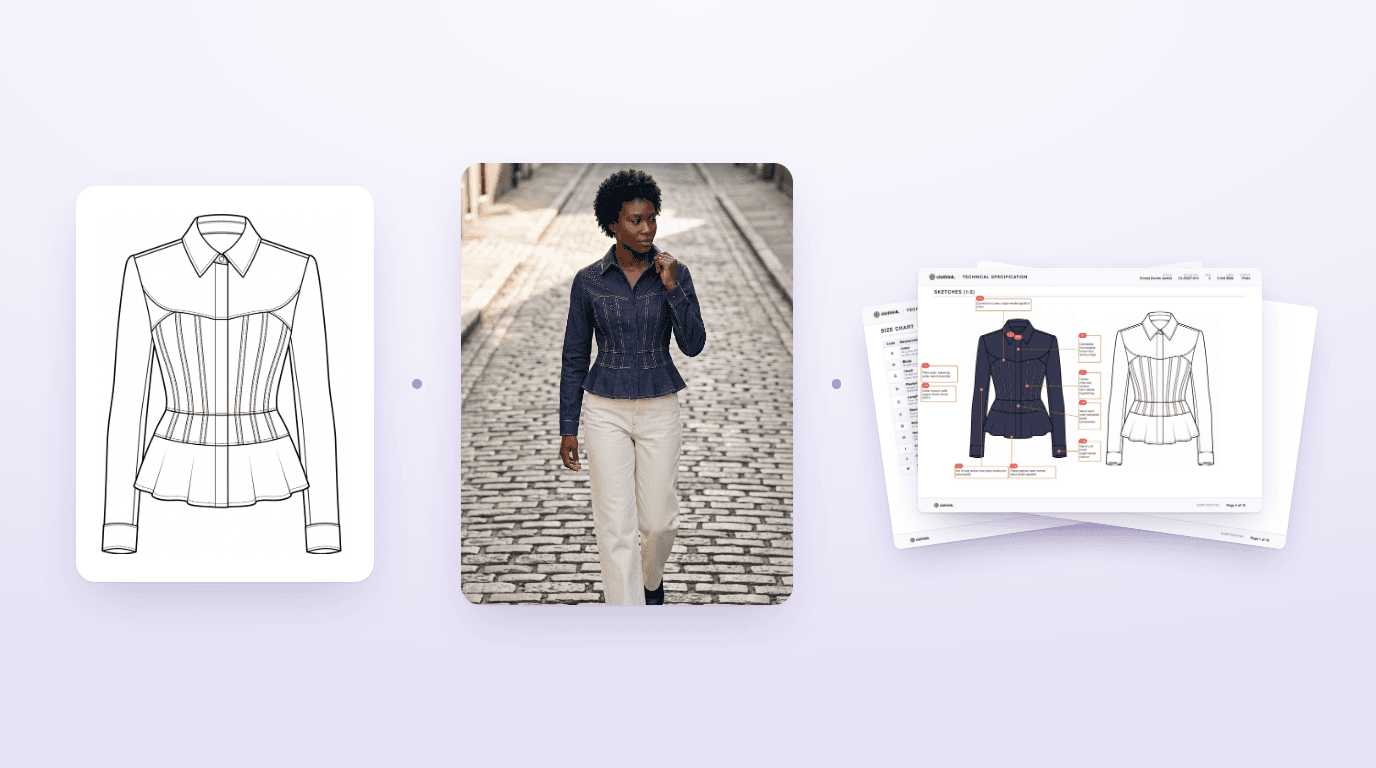
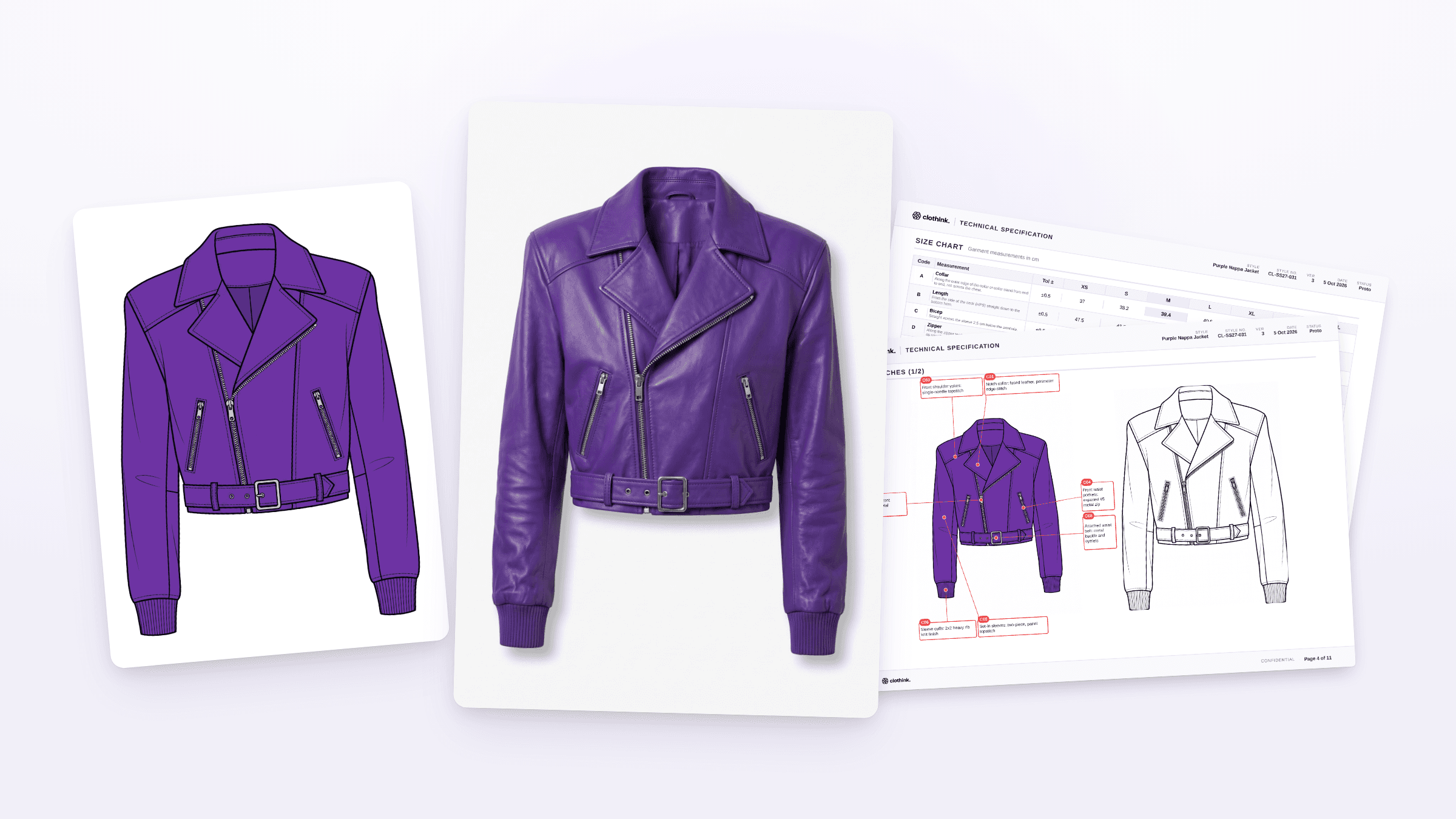
clothink is an AI product development workspace for apparel. You shouldn’t need to master Illustrator or build complicated spreadsheets just to create your first tech pack. Describe a garment, upload a sketch or start from a photo. The same style then carries you through technical flats and photoreal mockups to the tech pack. You get a flat sketch with call outs, measurements, material lists and construction notes, all editable, to review before you send them to your manufacturer.
What Auto-Complete drafts for you: it reads the style's sketch and mockup and drafts the bill of materials, a graded size chart with tolerances, construction notes, fabric and colour specifications, numbered call outs on the sketch and a How to Measure guide. Every section stays editable, packs export as a branded PDF and an Excel workbook, and a revision is kept each time the pack moves forward a stage.
Auto-Complete agent
Building your tech pack with AI
Visual analysis
Materials & colours
Size chart
How to measure
Bill of materials
Construction notes
Call outs
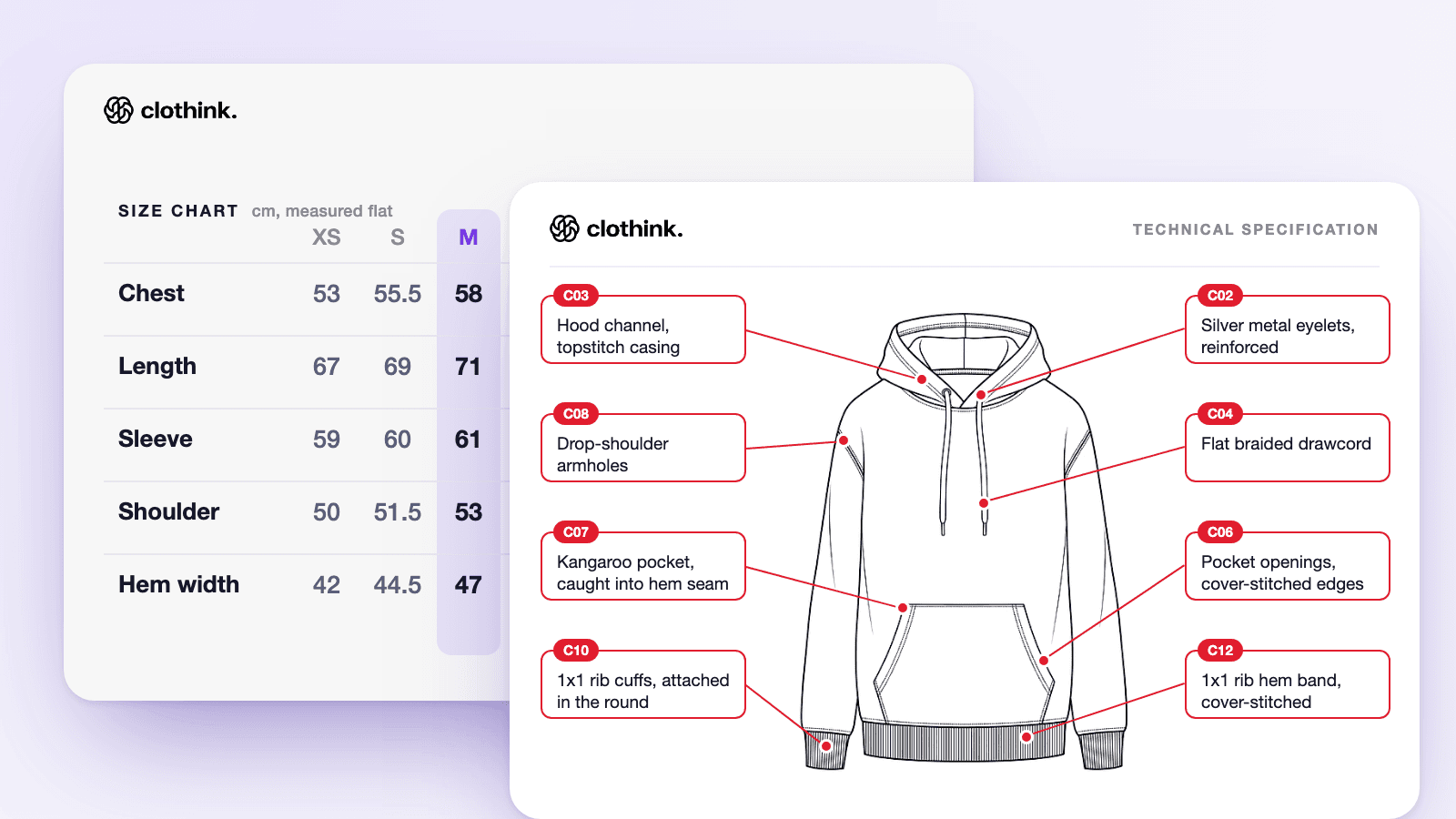
Here is what a drafted pack looks like: the size chart and bill of materials for a pullover hoodie, beside its mockup and flat sketch.
Everyday Pullover Hoodie
CL-AW27-008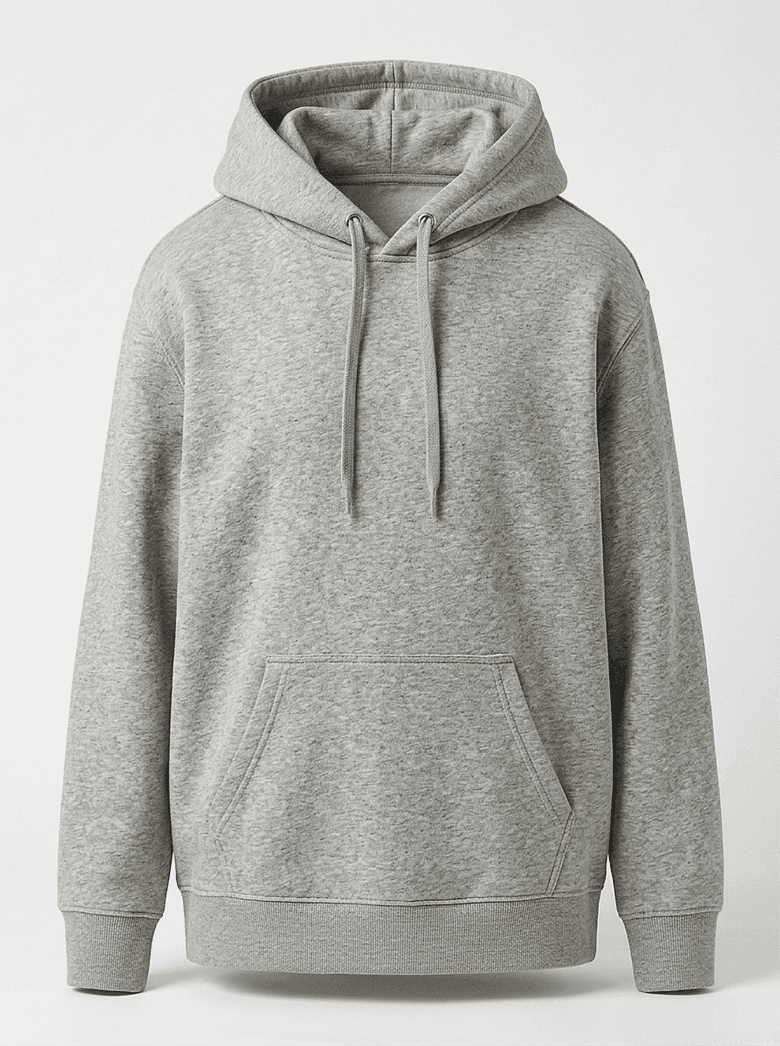
Mockup
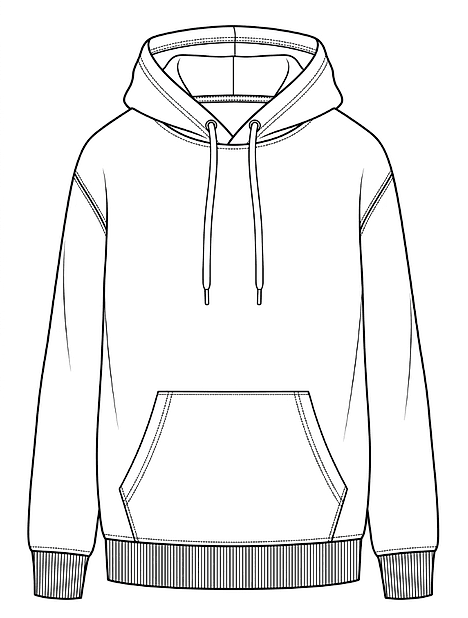
Flat sketch
Size specification (cm)
| Measure | Tol. | XS | S | M | L | XL |
|---|---|---|---|---|---|---|
| Chest | ±1 | 53 | 55.5 | 58 | 60.5 | 63 |
| Length | ±1 | 67 | 69 | 71 | 73 | 75 |
| Sleeve | ±0.75 | 59 | 60 | 61 | 62 | 63 |
| Shoulder | ±0.75 | 50 | 51.5 | 53 | 54.5 | 56 |
| Hem width | ±1 | 42 | 44.5 | 47 | 49.5 | 52 |
Bill of materials
| Type | Item | Spec |
|---|---|---|
| Fabric | Brushed-back fleece, 80% cotton 20% polyester | 340 gsm |
| Fabric | 1x1 rib knit, 95% cotton 5% elastane | 420 gsm |
| Trims | Flat braided cotton drawcord, plastic aglets | 8 mm |
| Trims | Metal eyelets, silver, nickel-free | 8 mm |
| Fabric | Herringbone twill neck tape, 100% cotton | 10 mm |
Want to see a complete finished pack? Our nine-page hoodie tech pack example goes through every page, with the PDF and Excel to download.
How clothink helps you catch mistakes: a pack that looks professional can still contradict itself, so checking is part of the workflow. When Auto-Complete drafts a pack, it finishes with a second look that compares the bill of materials, construction notes and fabric list with your drawing. It then lists anything you need to decide, such as two sections that disagree, before anything is added to your pack.
Before you export: clothink also checks the size chart, bill of materials and construction notes against each other, using fixed rules rather than AI. It marks each point as a likely error or something worth a look: sizes in the wrong order, a half measurement entered as a full one, measurements that contradict each other, a trim described two ways, or the same detail given two different values. A count appears in the Export menu, and nothing stops you exporting, so the decision stays yours. A checklist shows which sections still need work, and once samples come back you can record each fit round against the spec. These checks are a second pair of eyes, not a replacement for someone who knows garment manufacturing.
Everyday Pullover Hoodie
CL-AW27-008Check before you send· 2 likely errors · 2 to check
Warnings only. You can still export.
- Likely errorChest reads 116 cm at M. Widths here are half, laid flat, so this looks like the full measurement all the way round.
- Likely errorShoulder has a tolerance of 0. Factories read that as "exact"; give it a ± value.
- CheckA call out gives the hem width as 44 cm; the size chart says 47 cm.
- Check2 measurements have no tolerance: Sleeve and Length.
What it does not do: clothink does not produce graded sewing patterns, simulate fit or offer a factory portal or PLM planning, so large technical departments with those needs should look elsewhere. Auto-Complete drafts are starting specifications, not approved production instructions. Someone who knows garment manufacturing still needs to review them, as the section below shows.
Pricing: the Free plan needs no card and includes 10 starter tokens and up to three active tech packs you can build and edit. The first Auto-Complete run is free, then it costs three tokens on the Free plan and is included on paid plans. Unlock one pack for £15 to download its PDF and Excel, or choose a paid plan from £19 a month. See clothink pricing. Try it on your own garment: start free, no card needed.
The alternatives, and when to choose them
Each offers an AI-assisted approach to technical documentation. Here is how each differs from clothink and when it may suit you better.
AI Tech Packs: for teams documenting existing designs
AI Tech Packs is built around technical documentation rather than creating the garment. Start from a garment image, sketch or flat, and it drafts flat sketches, measurements, a bill of materials, artwork and construction details. The Tech Pack membership includes unlimited tech packs and flat sketches, Illustrator Connect, factory-sharing links and licensed Pantone colour matching. A built-in review, Techpack Mama QC, gathers the details that may need attention in one place. A cheaper Flat Sketch membership ($75 per seat a month) covers sketches only, with editable SVG export.
Choose it if you already have designs and an Illustrator workflow. It is not built to help you create the garment itself. The Tech Pack membership is $150 per seat a month (20% off with annual billing), advertised as unlimited generation subject to fair use. For occasional use, its changelog says a tech pack costs 20 credits at $1 each, about $20 (4 October 2026), and its credit packs never expire. That is a fair one-off price. The difference from clothink is the workflow. You bring the design to AI Tech Packs, while clothink also helps you create it.
Raspberry AI: for image-led teams with a pack to follow
Raspberry AI is a broader AI fashion design platform. Its Tech Pack feature works from garment images and generates front, back and side flats, editable annotations, points of measure, a bill of materials, colourways and artwork call outs. You can attach one of your existing tech packs as a reference, so the output follows your team’s format, fields and measurement conventions. You can also regenerate a single flat view, such as the back after a pocket change, without redrawing the rest. Materials are copied into a pack, so later changes to a library item do not update packs already made.
Choose it if your team is image-led, already has a pack format to follow and can budget per user. The Individual plan is $49 per user per month (120 credits), with Basic at $198 and Pro at $298 per user per month. Its pricing page lists no separate tech pack charge, so confirm what a pack costs in credits. Test the feature on your own garment categories before committing.
The New Black AI: for converting photos and existing packs
The New Black AI has a tech pack editor inside a wider fashion AI platform. Its AI reads photos of an existing garment and drafts the description, measurements, bill of materials and construction notes, and it can draw the flat sketches. You can also start from your own front and back sketches. You can rename and add sections, import an existing pack from its PDF, and run an AI review that lists the questions a factory would likely ask.
Choose it if you have photos or an existing pack to work from and are happy to complete much of the document by hand. Building and exporting a pack by hand is free with no watermark (two packs without a plan), and paid plans start at $15 a month. AI steps use credits: 1 to draft a pack from photos plus 1 per flat sketch, 2 to import and 2 for the review. The catch is the input. A photo cannot confirm fabric composition, supplier references or finished measurements. The New Black says as much. Its draft “is meant to be corrected: you keep what is right and fix the rest.”
Akwa: for sample-stage packs with assumptions labelled
Akwa generates tech packs from designs made on its platform or from a photo of your design. Each pack has multi-view flats with numbered call outs, a bill of materials, graded measurements, a construction sequence and a QC checklist. Its distinguishing feature is provenance. It labels what it observed in your design separately from what it engineered, so a factory knows what to confirm. It also checks each pack against your design and runs it past a separate automated reviewer.
Choose it if making assumptions explicit is your priority. Akwa describes every pack as a factory-oriented sample tech pack, prepared for sampling and quotation rather than bulk production. Automated review cannot replace sampling, fit approval or material testing. A standalone pack costs €25. The Tech Pack Plan is €49 a month for three packs, €139 for ten or €189 for fifteen, with design credits billed separately.
What a manufacturer actually checks in an AI-generated tech pack
Look beyond the feature lists. A factory uses a tech pack to estimate material use, price labour, source components, cut patterns and make a first sample. Where it is incomplete or contradictory, the factory has to guess or come back with questions. These are the six checks I would run on any pack, whoever or whatever wrote it.
- Does the drawing agree with the words? A flat can look professional and still contradict the notes. A cargo trouser drawn with two snaps per pocket flap but a BOM listing one, or a gusseted pocket drawn while the notes describe a flat patch pocket, leave the factory choosing. clothink’s built-in checks can flag some mismatches of this kind.
- Can the materials be sourced? “Heavy cotton twill” is not a specification; a fibre composition and weight is. The table below shows the difference.
| Incomplete specification | More useful specification |
|---|---|
| Heavy cotton twill | 100% cotton woven twill, 260 gsm, garment washed |
| Black zip | Black nylon coil zip, #5 gauge, 60 cm closed length, measured teeth only |
| Cotton rib | 1x1 rib, 95% cotton and 5% elastane, 320 gsm, 30% stretch |
- Are the measurements usable? A size chart needs a stated measuring position for each point, flat or circumference, a base size, a grade and a tolerance. An elasticated waist may need measuring both relaxed and extended. A clear How to Measure diagram keeps brand and factory measuring the same way.
- Are decisions separated from assumptions? Picture a waterproof jacket photo. AI can identify the hood, zip and pockets, but it cannot tell from a mockup whether the fabric has a hydrostatic head of 5,000 mm or 10,000 mm, or whether the seams are taped. Those values need deciding, sourcing and testing, and a good workflow keeps them visible rather than letting a suggested value pass as approved.
- Can you revise without contradictions? Change a pocket, a sleeve length or a zip and several sections move. The tool should make it easy to update drawings, BOM, measurements and notes together, and to see which version is current.
- Can the factory use the files? PDFs are good for review; spreadsheets help with measurement tables and costing. Confirm which files you get, whether they stay editable and whether exports are included in the price.
We reviewed and corrected our own hoodie pack before export. Auto-Complete’s draft of the kangaroo pocket said to turn under all of its edges, the way a patch pocket is built. We designed the bottom edge to be caught into the hem band seam, so we changed the note to leave that edge raw and enclose it in the seam. The two instructions describe different ways of making the pocket, and a factory following the first would have built it differently from our design. The finished pack, with its 21 measurement points, 14 construction notes and 11 call outs, is in our hoodie tech pack example.
A test you can run on any tool before paying
You do not need a whole collection to evaluate a tool. Pick one garment with enough detail to expose inconsistencies, such as a utility overshirt. Give every tool the same starting point in whatever form it accepts, whether that is a written description, a sketch or a photo, and keep a note of what the garment should be:
A unisex utility overshirt in 260 gsm cotton twill, with a relaxed, boxy fit and dropped shoulders. Two symmetrical chest patch pockets with flaps, six concealed snaps down the centre front and one snap on each pocket flap. Back yoke, straight hem, 5 cm side vents and no lining. Sizes XS to XXL, base size M.
Check the first draft against that list. Does every detail appear, and has the tool added anything you did not ask for? Then make one change: replace the six concealed centre-front snaps with an exposed zip and leave the pocket closures alone. That one edit should trigger these checks:
| Part of the pack | What needs reviewing |
|---|---|
| Technical drawing | Front opening now shows the exposed zip |
| BOM | Six front snaps removed, two pocket snaps kept, zip added |
| Construction notes | Centre-front fastening instructions changed |
| Measurements | Zip length and front-opening dimensions checked |
| Brand-only details | Supplier references and colour codes stay blank, not invented |
It shows whether a tool only produces a first document or also supports the revisions real development involves.
How much does an AI tech pack generator cost?
Is it cheaper to pay per tech pack or subscribe? It depends on how many garments you are developing. Paying per pack suits one or two styles. clothink’s one-off unlock is £15 per pack, against about $20 for one pack at AI Tech Packs and €25 at Akwa. Subscriptions suit regular use, extra design features and teams. On clothink, unlocking two packs in the same month costs £30, more than a £19-a-month Creator plan, which includes exports. So for one garment, pay per pack; for a small collection, a subscription is usually cheaper. Whichever you choose, check that you can download the finished file and what the price includes.
Can AI-generated tech packs go straight to a manufacturer?
Yes, once reviewed and detailed enough for the stage. Quotation, sampling and bulk production need different amounts of information, and AI helps most at the first two. It cannot confirm how a garment fits a person, verify fabric performance or approve a production pattern. For what factories need to quote accurately, read our guide to writing a tech pack a manufacturer can quote from. For traditional tech pack builders, 3D systems and PLM, see the best tech pack software for fashion brands.
Frequently asked questions
What is the best AI tech pack generator for a small clothing brand?
It depends on who you are. For independent designers and small brands who want to develop a garment and its tech pack in one place, clothink is our pick, and it starts free with no card. Teams documenting existing designs may prefer AI Tech Packs, image-led teams with a reference pack may prefer Raspberry AI, and The New Black and Akwa suit converting photos and labelling assumptions respectively.
Can I make an AI tech pack for free?
Yes, several offer free plans or starter credits. clothink lets you create and edit up to three active tech packs for free, with the first Auto-Complete run included. Unlocking a pack for PDF and Excel download costs £15, or exports are included on a paid plan. Check the full cost of other tools before choosing.
Can I create a factory-ready tech pack from a garment photo?
You can create a draft from a photo, but it needs review before it is factory-ready. Several platforms generate technical drawings, measurements, BOMs and construction notes from a garment image. A photo cannot reliably show hidden construction, fabric composition, approved fit or physical performance, so those need to be supplied or confirmed separately.
Can AI make sewing patterns from a tech pack?
A tech pack describes the garment and how it is built; a sewing pattern defines the pieces that are cut and assembled. The tools covered here should not be assumed to replace a pattern cutter or production pattern-making software.
Are AI tech packs accurate enough for manufacturing?
They are a useful starting point for quotations and sampling after technical review. Check the graded size chart against your intended fit and measuring methods. Accuracy depends on the input, the complexity of the garment and the quality of the review, and bulk production still needs physical approvals and quality controls.
Which AI tech pack generator should you choose?
AI tech pack generators now save real time on drawings, measurement tables, material lists and construction notes, but the software is only part of the process. For independent designers and growing clothing brands, clothink is our top recommendation. It brings garment design, realistic mockups and editable technical specifications into one workspace, with built-in checks, and you can start free and pay £15 only when you are ready to send a pack to a factory. If you are a technical team with existing designs, AI Tech Packs or Raspberry AI may fit your workflow better, and a large PLM-based department will need more than any of these provides.
Whichever you choose, the final check is the same: would a manufacturer reading this specification know exactly what you want made, and which details you still need to supply? If not, the document still needs work, however quickly it was generated.
Create your first tech pack with clothink
Start with an idea, sketch or garment photo. Develop your design, generate an editable tech pack and review the details before exporting. Create your first specification for free, with no credit card required. When you are ready, unlock the finished PDF and Excel files for £15, or choose a subscription for ongoing development.
About the author: Gianni Romano is the founder of clothink and co-founder of Lyfcycle, an apparel sourcing and manufacturing business. His experience working with clothing brands, fabric suppliers and garment factories informs clothink's approach to AI-assisted product development and technical documentation.